
The first period of my career was just like a childhood dream came true. That was exactly what I’d like to study, what I’d like to become.
[2009 – 2013]
Ph.D. and Researcher
in Nuclear Material Physics
[2013 – 2016]
R&D Engineer
in Water Chemistry
of Nuclear Power Plant
2009 – 2013
Ph.D. and Researcher @ Ecole Polytechnique of Paris
The Ph.D. successful defense (pdf file available here or here, in French) and five articles/conference-papers were published during the period at Ecole Polytechnique of Paris.
Competence developed over my first professional experience:
Scientific competence:
- Titanium – Zirconium
- Thermal Oxidation – Corrosion
- Solid-Solid Diffusion
- Ionic Irradiation
- Superficial Damage
- Surface/Interface Analysis
- Scanning Electron Microsopy (SEM)
- Atomic Force Microscopy (AFM)
- Spectroscopic Ellipsometry (SE)
- X-ray Photoelectron Spectroscopy (XPS)
- Nuclear Backscattering Spectroscopy (NBS)
- Monte-Carlo Simulation for Irradiation
Soft skills:
- Paper/scientific-article writing
- Conference presentation
- Problem solving
- Self-directed learning
The overview of all my scientific publications will be shown here:


Ngoc-Long Do et al.
- Ngoc-Long Do
- Enric Garcia-Caurel
- Nicolas Bérerd
- Nathalie Moncoffre
- Dominique Gorse-Pomonti
Published: May 15, 2014
Summary
This paper reports on a recent study of the corrosion under argon ion irradiation of titanium in the low MeV range (1-9 MeV), associating AFM and Spectroscopic Ellipsometry. Irradiation with MeV Arn+ (n = 1, 3) ions produces damages on the titanium surface.
Large craters form on the oxidized titanium surface whose characteristics vary as a function of the argon energy between 2 and 9 MeV. The superficial oxide grows thicker under irradiation over the same energy range, especially near 3 MeV. It is suggested that collisions cascades play a significant role in the overall damage process.

Ngoc-Long Do et al.
- Ngoc-Long Do
- Enric Garcia-Caurel
- Nicolas Bererd
- Nathalie Moncoffre
- Dominique Gorse-Pomonti
Published: April 2014
Summary
In this article we present a study of the oxidation of pure titanium bulk samples under argon ion irradiation at 500°C under rarefied air. In particular we follow the dependence of the oxide thickness as a function of the energy of argon ions. The novelty of this study consists in the range of ion energy explored, from 1 to 9 MeV.
Until very recently it was commonly accepted that metal surfaces were transparent to ion beams in this low energy range (few MeV), and no surface modifications were expected. In a previous paper by the authors of this work, the formation of shallow craters in the surface of titanium was reported as a result of argon ion bombardment with energies of 2, 4 and 9 MeV under the same environmental conditions.
We show here that around 3 MeV the oxide growth is unexpectedly enhanced. We think that an interplay of electronic excitations and nuclear ballistic collisions could possibly explain this enhanced oxide growth. We have used spectroscopic visible ultraviolet ellipsometry and XPS to determine the thickness of the oxide layers and characterize their optical properties.
From the optical properties of the oxides we observed that for ion energies below 3-4 MeV the oxides show a dielectric-like behavior, whereas for ion energies above 3-4 MeV the oxides show a metal-like behavior. These findings indicate also that ion bombardment in this energy range may change substantially the oxygen-to-titanium ratio in the oxide films grown under irradiation leading to the formation of titanium sub-oxides.



Dominique Gorse-Pomonti, Ngoc-Long Do et al.
- Dominique Gorse-Pomonti
- Ngoc-Long Do
- Nicolas Bérerd
- Nathalie Moncoffre
- Gianguido Baldinozzi
Published: April 01, 2013
Summary
We studied the irradiation effects on Ti and Zr surfaces in slightly oxidizing environment (rarefied dry air, 500°C) using multi-charged argon ions in the low MeV range (1 – 9 MeV) to the aim of determining the respective role of the electronic and nuclear stopping power in the operating oxidation process under irradiation
We have shown that ballistic collisions contribute significantly to the enhanced Ti and Zr oxidation under MeV argon bombardment We have also shown that the projectile energy plays a significant role in the overall process. A significant oxide film thickening is visible on titanium under irradiation, taking the form of a well-defined oxidation peak between 1 and 4 MeV, as a result of the Nuclear Backscattering Spectroscopy and Spectroscopic Ellipsometry studies.
A significant oxide film thickening is also visible on zirconium under same irradiation conditions, at 4 and 9 MeV, as a result of the NBS study. Work is in progress in order to determine how the modified oxidation process depends in this case on the projectile energy.
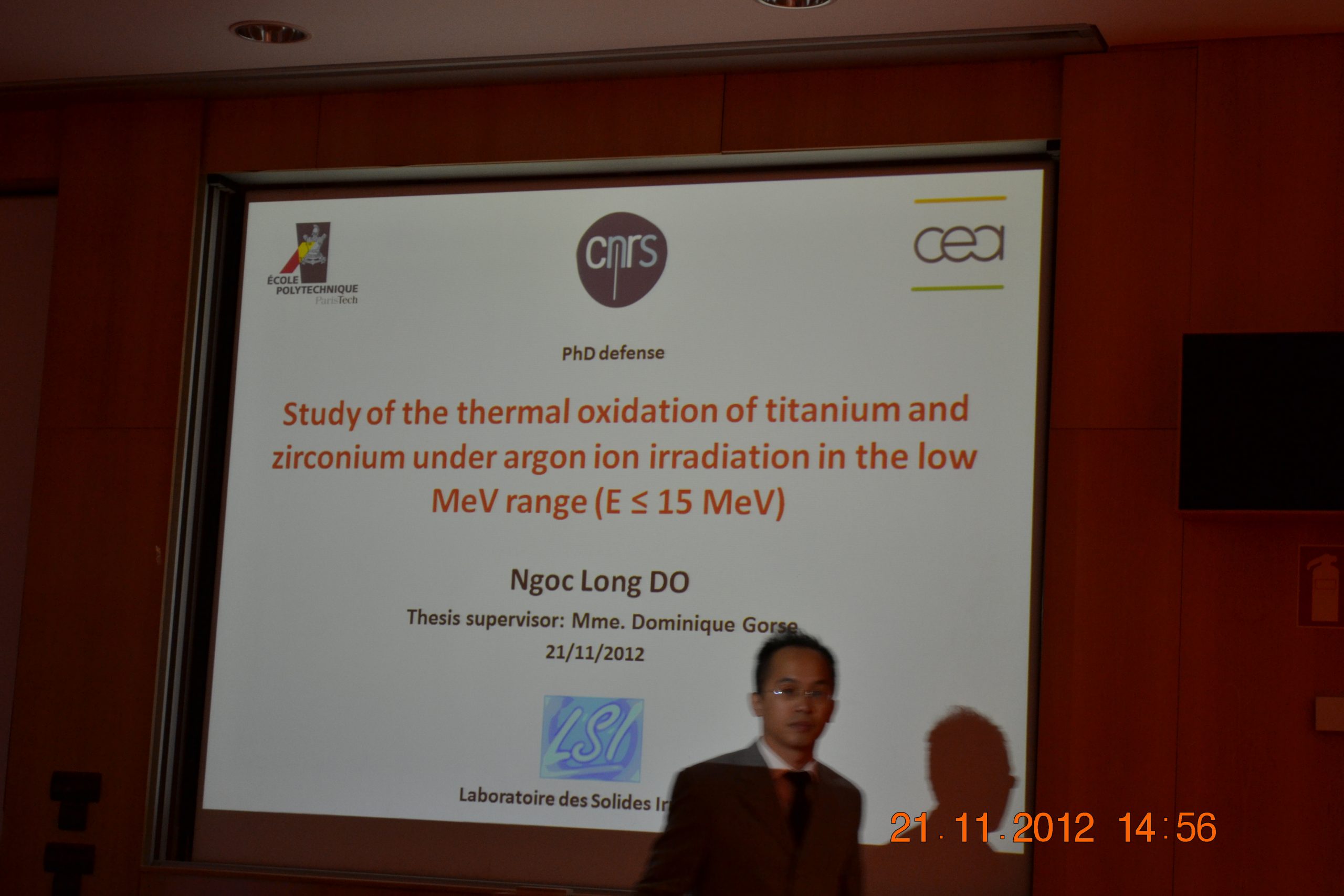
Ph.D. Defense
Study of the thermal oxidation of titanium and zirconium under argon ion irradiation in the low MeV range (E ≤ 15 MeV)
Ngoc-Long Do
Committee:
- Lionel Thomé
- Jacques Cousty
- Dominique Gorse-Pomonti
- Nathalie Moncoffre
- Isabelle Monnet
- Thierry Gacoin
- Yves Serruys
- Enric Garcia-Caurel
Ph.D. defense: November 21, 2012
Thesis published: January 24, 2013
Summary
We have shown that argon ion irradiation between 1 and 15 MeV produces damage on both titanium and zirconium surfaces, taking the form of accelerated oxidation and/or craterization effects, varying as a function of the projectile energy and the annealing atmosphere (temperature and pressure) simulating the environmental conditions of the fuel/cladding interface of PWR fuel rods.
Using AFM, we have shown that the titanium and zirconium surface is attacked under light argon ion bombardment at high temperature (up to 500°C) in weakly oxidizing medium (under rarefied dry air pressure ranging from 5,7 10-5 Pa to 5 10-3 Pa) for a fixed fluence of about 5 1014 ions. cm-2. We observed the formation of nanometric craters over the whole titanium surface irradiated between 2 and 9 MeV and the whole zirconium surface irradiated at 4 MeV, the characteristics of which vary depending on the temperature and the pressure. In the case of the Ar/Ti couple, the superficial damage efficiency increases when the projectile energy decreases from 9 to 2 MeV.
Moreover, whereas the titanium surface seems to be transparent under the 15-MeV ion beam, the zirconium surface exhibits numerous micrometric craters surrounded by a wide halo. The crater characteristics (size and superficial density) differ significantly from that observed both in the low energy range (keV) where the energy losses are controlled by ballistic collisions (Sn) and in the high energy range (MeV – GeV) where the energy losses are controlled by electronic excitations (Se), which was not completely unexpected in this intermediate energy range for which combined Sn – Se stopping power effects are possibly foreseen.
Using XPS associated to ionic sputtering, we have shown that there is an irradiation effect on thermal oxidation of titanium, enhanced under the argon ion beam between 2 and 9 MeV, and that there is also an energy effect on the oxide thickness and stoichiometry.
The study conducted using Spectroscopic Ellipsometry on the oxide films grown between 1 and 9 MeV confirmed these results and showed precisely that there is an oxidation peak as a function of the argon ion energy, found maximum at 3 MeV under present experimental conditions.
The oxygen gain measurements obtained by NBS confirm the presence of this oxidation peak. Until now, the results obtained by NBS concerning the thermal oxidation of zirconium under argon irradiation at 4 and 9 MeV confirm the previous works done by the ‘Aval du Cycle Electronucléaire’ group of the ‘Institut de Physique Nucléaire de Lyon’, and strongly suggest the existence of the oxidation peak in the same projectile energy range, as for titanium.



Ngoc-Long Do et al.
- Ngoc-Long Do
- Nicolas Bérerd
- Nathalie Moncoffre
- Feng Yang
- Patrick Trocellier
- Yves Serruys
- Dominique Gorse-Pomonti
Published: December 2011
Summary
Oxide films thermally grown on titanium in a weakly oxidizing environment (5 × 10⁻³ Pa of dry air) under irradiation with 2, 4 and 9 MeV argon have been studied.
The AFM study reveals a cratering effect of 2, 4 and 9 MeV argon and a significant surface roughening effect of 2 MeV argon, both effects being largely unexpected in this energy range.
The XPS analysis shows that the TiO2 stoichiometry of the superficial oxide film is fairly well maintained under argon irradiation.
The Spectroscopic Ellipsometry analysis reveals an oxide film thickness multiplied by a factor of three under irradiation with 2 MeV argon by comparison with 9 MeV argon, the irradiation effect on oxide growth remaining very limited for 4 or 9 MeV argon.
The possible role of the electronic but most certainly of the nuclear energy losses on the surface damage mechanism are discussed. It is suggested that the oxidizing environment is necessary to freeze the instantaneous surface damage and permits the post-mortem observation.

Ngoc-Long Do et al.
- Ngoc-Long Do
- Nicolas Bérerd,
- Nathalie Moncoffre
- Dominique Gorse-Pomonti
Published: February 01, 2011
Summary
The study of the irradiation effects on titanium surfaces in oxidizing environment using multi-charged Argon ions in the MeV range shed into light the following points:
- Significant oxide film thickening for the film grown at 500°C under irradiation at 4 and 9 MeV, by comparison with the TiO2 rutile film grown under same environmental conditions without irradiation;
- Formation of large round-shaped craters, of diameter approaching 200 nanometers, at the titanium surface under irradiation at 500°C provided that the environment is enough oxidizing or provided that the metal surface is covered by a sufficiently thick oxide film.
Practically, and for the present system, the superficial craterization is observed if the thickness of the superficial oxide is equal to twice that of the native oxide (~3 nm).
2013 – 2016
R&D Engineer in Water Chemistry of Nuclear Power Plant @ AREVA NP
This was an academy – entreprise transition in my career. Tenical Center of AREVA NP is where I could do scientific research in the industrial nuclear field, and manage real-world projects with different operational teams.
Competence developed over my second professional experience:
Scientific competence:
- Nickel-based alloys
- Metallurgy (600, 690, 314L alloys)
- Cation (Ni, Fe) release
- High Temperature-Pressure Corrosion
- Liquid-Solid Diffusion
- PWR Water Chemistry (Boron & Lithium Effect, Hydrogen & Oxygen Solubility)
- Surface/Interface Analysis
- Scanning Electron Microsopy – Field Emission Gun (SEM-FEG)
- Polarography
- Inductively Coupled Plasma Mass Spectrometry (ICP-MS)
- Glow Discharge Optical Emission Spectroscopy (GD-OES)
Soft skills:
- Project management
- Entreprise communication
- Team collaboration
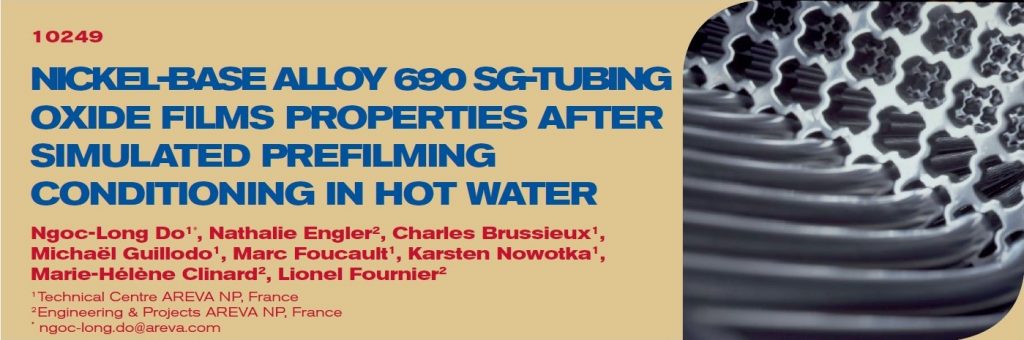
A paper and a poster were submitted for the Nuclear Plant Chemistry Conference for Sapporo (Japan) in 2014. Here is the abstract:
Nickel base alloy 690 SG-tubing cation release measurements in simulated PWR primary water and oxide film properties
Ngoc-Long Do et al.
- Ngoc-Long Do
- Nathalie Engler
- Marc Foucault
- Karsten Nowotka
- Marie-Hélène Clinard
- Lionel Fournier
- Charles Brussieux
- Michaël Guillodo
Submited: October 2014
Summary
Various alloys are currently used for the tubing of Steam Generators (SG) in Pressurized Water Reactor (PWR). In France, the use of the nickel-base alloy 690TT for SG-tubing is progressively generalized because of its resistance to stress corrosion cracking in primary water. However, in the primary circuit, nickel-base SG-tubing (due to oxidation induced cation release of Co, Ni and Fe) is a major source of coolant activity and surface radioactive contamination. The mechanisms at the origin of cation release remain unclear but it is known that the release is determined by an interaction between chemistry (pH, temperature and oxygen/hydrogen), metallurgy and history of the material. This study was undertaken to investigate the impact of elevated pH or redox potential on the nature of the oxides formed on recent A690TT industrial tubes.
For this investigation at the laboratory scale, a titanium re-circulating loop (“PETER”) was used. This loop is able to simulate primary water chemistry in terms of Li, B, O2/H2, pressure and temperature. This loop permits the measurement of the release kinetics of corrosion products during a test by feeding as-received industrial tube samples with a solution depleted with nickel and iron and by measuring the nickel and iron traces at their outlet. Ni concentration measurements were performed by differential pulse polarography and ICPMS. Experimental cation release test-runs were performed by varying water chemistry parameters at 300°C. Physico-chemical characterizations (GD-OES, SEM, EDS) were carried out before and after the tests to determine oxide film properties.
The best results regarding Ni-release and oxides properties (chromium content and thickness) were obtained by using the elevated pH – reducing chemistry.
Keywords: Alloy 690, steam generator tubes, nickel release, PWR primary coolant, water chemistry, corrosion products